
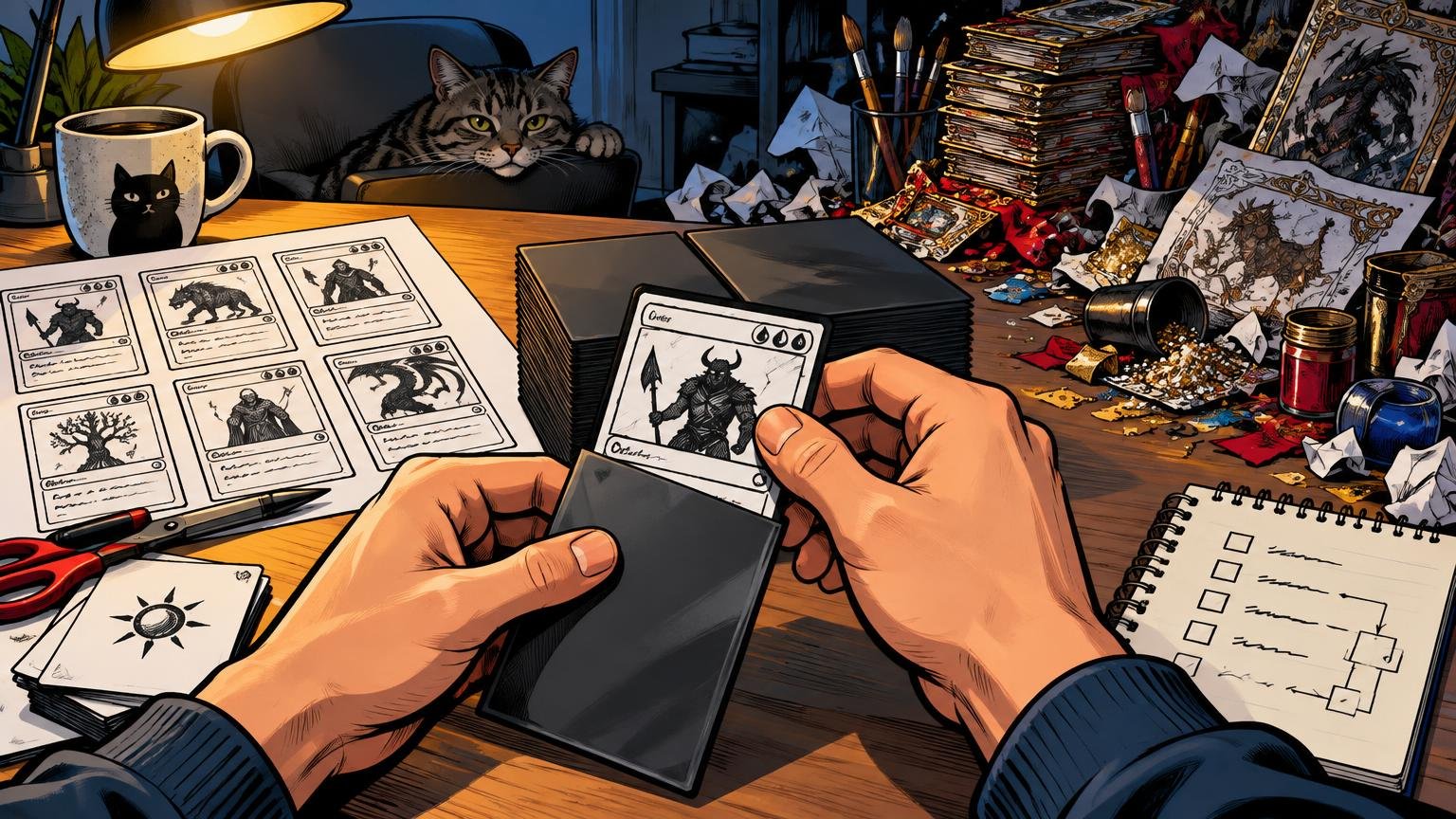
TLDR: The fastest answer to how to proxy MTG deck for testing is to make plainly non-authentic, text-forward inserts; place them in matching opaque sleeves with uniform backing cards; and test one printed sample before producing the whole deck. Record your deck version and the question you want each session to answer. These playtest cards are for private testing or groups that expressly permit them, not sanctioned Magic events.
A testing deck does not need border-perfect art, collector-grade cutting, or enough printer ink to summon an Eldrazi. It needs to be readable, consistent while shuffled, and easy to revise. Ask the store, event organizer, or playgroup before bringing it to a Commander night or other gathering because Wizards’ position on personal playtest cards does not establish every venue’s policy.
Know the boundary before making playtest cards
Wizards distinguishes personal, non-commercial playtest cards from counterfeits in its 2016 policy statement and says it does not intend to police such playtest cards outside sanctioned events. That statement is not universal permission from stores, conventions, leagues, or playgroups, so obtain approval from whoever runs the game. Keep the cards unmistakably temporary and non-authentic rather than trying to reproduce genuine cards convincingly.
The boundary for sanctioned play is much firmer. The Magic Tournament Rules dated February 27, 2026 say authorized cards must be genuine, regulation-sized Magic cards publicly released by Wizards and that players may not create their own tournament proxies. A head judge can issue a tournament proxy only in limited circumstances, such as specified damage or wear occurring during the event and certain foil-only cards. That judge-issued card is valid only for that tournament. Read the current Magic Tournament Rules
In other words, a home proxy deck helps you decide whether a list deserves your money and practice time. It does not turn into a tournament deck because the sleeves are good or the printing looks convincing.
How to proxy MTG deck for testing efficiently
1. Freeze the list and choose one testing question
Save a version of the decklist before touching the printer. Record the format, date, version number, commander where applicable, sideboard, companion, and any deliberate substitutions. Check the list against the current official Magic rules resources and banned-and-restricted information before interpreting your results as tournament preparation. Format legality changes, and a smooth test session cannot make an illegal list legal.
Give the session one primary question. “Is this deck good?” is too foggy. Better questions include:
- Can the opening hands cast useful spells on schedule?
- Does the mana base reliably produce the required colors?
- Is a proposed interaction package too narrow for the expected matchups?
- Does the Commander deck function when its commander is removed twice?
- Is an expensive staple genuinely better here than the card it would replace?
- Does the deck have enough threats, answers, or card selection after turn five?
If cost is driving the experiment, start with the uncertain purchases rather than proxying cards you already know you want. Our guide to the best MTG cards to proxy before buying offers a practical shortlist of high-cost categories worth testing first.
2. Build for legibility, not realism
Every insert should show the card name, mana cost, type line, rules text, and any relevant power, toughness, loyalty, defense, or color-indicator information. Include both faces or a clear reference for double-faced cards. Add the card’s role—such as removal, ramp, or draw—in a small note if that will help with later revisions.
Wizards’ discussion of internal playtest cards emphasizes including the information needed to use a card. Experienced testers may work from an abbreviated name-and-cost slip, but that shortcut becomes annoying when anyone at the table must repeatedly check the wording. Use full rules text for unfamiliar cards, complicated triggers, modal spells, and anything whose timing matters.
Text-only or low-ink layouts are usually the better first draft. They print quickly, remain visibly non-authentic, and discourage spending an hour choosing art for a card that may be cut after six opening hands. Specialist resources such as MTG proxy tools and resources can provide another route when you want help preparing a test deck, but clarity should remain the goal.
3. Print and trim one sample first
Do not send the entire deck to the printer immediately. Print one sample containing a long card name, several lines of rules text, and small symbols. Trim it inside the blank margins, put it into the intended sleeve with a backing card, and inspect it under ordinary table lighting.
Confirm that the text is readable, the insert sits flat, and important content has not been clipped. Printer scaling, margins, paper thickness, and layout software vary, so there is no universal setting or guaranteed number of cards per page. Adjust from the physical sample instead of trusting the preview window.
Standard card accessories commonly use the 2.5 × 3.5-inch or 63 × 88-mm size class. That gives you a useful fit target, not a promise that every printer-template-sleeve combination will behave identically. Dragon Shield, for example, publishes dimensions for its standard-size card sleeves.
4. Sleeve every card consistently
Place each paper insert in front of a uniform backing card, then use the same model and color of opaque sleeve throughout the deck. Spare basic lands or other low-value cards can serve as backing cards, provided they are physically consistent enough for your testing environment.
Sleeve the complete deck, shuffle it, draw several opening hands, and cut it as another player would. Replace any insert that folds, catches, slides out of position, or makes its card noticeably different while shuffled. Uniform assembly matters more than producing beautifully cut rectangles.
A testing deck can reveal mana problems only if you build the test list honestly. For Commander, establish a reasonable starting land count and mana plan rather than trimming lands to squeeze in every exciting spell. This guide to choosing a Commander land count explains the variables worth checking.
5. Cut quickly and keep a repair kit
A paper trimmer is faster and more consistent than scissors for a full deck, but perfection is unnecessary because the backing card defines the sleeved shape. Leave a little blank margin rather than risking clipped rules text. Avoid thick paper, layered adhesive, or uneven folds that change how individual cards handle.
Keep a small testing kit with blank slips, a pen, spare sleeves, and extra backing cards. When a card underperforms, write the replacement by hand and continue. The whole advantage of a proxy deck is that iteration should take two minutes, not trigger a fresh arts-and-crafts campaign.
6. Prepare tokens and double-faced cards
List every token, emblem, counter type, and double-faced card the deck can produce before game one. The Tournament Rules allow tokens and other game aids to be represented in any clear way both players understand, although a particular organizer can still set expectations for an event.
Label tokens with the characteristics that matter: name, colors, creature types, power and toughness, and abilities such as flying or vigilance. Use dice for quantities and separate markers for temporary counters when one die could become ambiguous. If the deck creates a small demon army, purpose-made Demon tokens for MTG may improve table readability, but labeled paper rectangles work for testing.
For double-faced cards, choose one repeatable system. You can use a checklist-style front insert and keep the reverse face nearby as a reference, or place both faces on one clearly labeled reference sheet. Avoid repeatedly removing cards from tight sleeves during play; it slows testing and damages the flow of the game.
Turn games into useful test results
Start with ten or more opening-hand drills before arranging a full multiplayer evening. Draw seven, make realistic mulligan decisions, and play through the first few turns without an opponent. Goldfishing will not measure interaction or politics, but it quickly exposes awkward color requirements, overloaded mana values, hands with nothing to do, and cards that cannot be cast on schedule.
Move next to representative opponents. A useful gauntlet might include a fast deck, a resilient value deck, and a strategy that attacks your list from an uncomfortable angle. It does not need to model an entire metagame. It needs enough variety to reveal whether your answer suite works only in the friendliest matchup.
For each game, record:
- Deck version and opponent or opposing archetype
- Whether you played or drew first
- Opening hand and mulligan count
- Turns when mana or color access failed
- Cards stranded in hand and the reason
- The pivotal turn or decision
- Whether the problem looked like deck construction, variance, a misplay, or a rules misunderstanding
- One proposed change rather than ten simultaneous changes
Do not overreact to one spectacular win or miserable loss. Look for repeated friction: the same dead card, missing color, empty hand, or threat you cannot answer. Change a small package, update the version, and test again. Controlled changes tell you more than rebuilding half the deck after every game.
Maintain a revision loop instead of reprinting everything
Use a simple version log with four columns: card out, card in, reason, and result. Keep removed candidates in a separate labeled section rather than mixing them into the active deck. When the list changes, print only the affected inserts.
Use version names that mean something, such as “v0.3—more early interaction,” rather than “final-final-actually-final.” Date each major version so notes from different sessions do not blend together. Once the deck performs the job you set for it, decide which genuine cards to acquire and which expensive slots deserve more testing.
Quick questions about MTG playtest cards
Are proxies allowed for private deck testing?
Wizards’ 2016 statement distinguishes personal, non-commercial playtest cards from counterfeits and says it does not intend to police those playtest cards outside sanctioned events. Keep them plainly non-authentic and confirm that everyone involved accepts them.
Can I bring a playtest deck to an LGS Commander night?
Ask first. A store event may be sanctioned, may prohibit playtest cards, or may permit them only under specific casual conditions. The playgroup, store, or organizer controls admission and table expectations.
Can self-made proxies be used in a sanctioned event?
No. The current Tournament Rules do not allow players to create their own tournament proxies. Limited tournament proxies may be issued by the head judge under the circumstances defined in those rules.
Do playtest cards need art or color printing?
No. Legible text and clear identification matter more than art. Text-forward, single-sided inserts are faster to make, cheaper to revise, and easier to recognize as testing pieces.
Can proxy games prove that a deck is format legal?
No. Testing shows how the deck behaves under the conditions you create. Check the official rules and current banned-and-restricted resource separately before treating the list as event-ready.
Make the rough draft do real work
The best testing proxy is not the prettiest one. It is the card that can be read across the table, shuffled without standing out, swapped in seconds, and traced to a specific deck revision. Begin with one sample insert, standardize the sleeves and backing cards, prepare the necessary game aids, and test a focused question. Once the list survives that loop, spend money on the version that earned it—not the first draft that merely looked exciting.
References
- On Proxies, Policy, and Communication | MAGIC: THE GATHERING
- MAGIC: THE GATHERING® TOURNAMENT RULES
- Rules | Magic: The Gathering
- Banned & Restricted | Magic: The Gathering
- A-Proxy-Mation | Magic: The Gathering
- That's a Good Card – Brushed Art Sleeves – Standard Size – Dragon Shield
- ECLIPSE® Matte Standard DECK PROTECTOR® Sleeves: Arctic White – 105ct – Ultra PRO International