
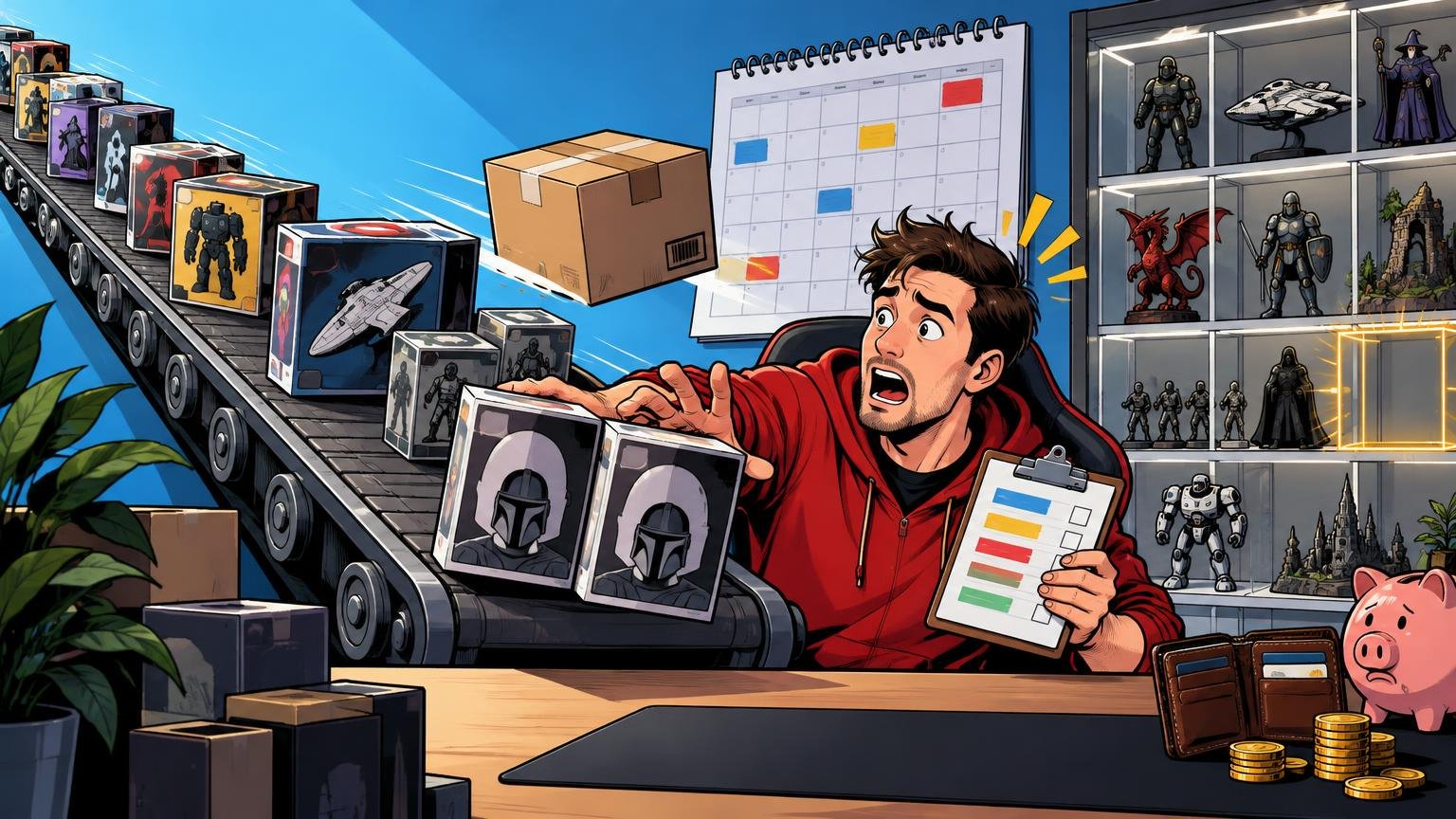
The safest preorder is one you could afford and display if every delayed item arrived next Friday. Collectible preorder budgeting should therefore track more than the price shown beside a shiny product render. Record the remaining balance, likely shipping and tax, cancellation exposure, release window and physical destination before placing the order.
That approach turns preorders back into purchases instead of interest-free loans from your future self. It also exposes the classic collector trap: six manageable orders quietly converging into one financially apocalyptic month.
TLDR: Track commitments, not just payments
- Record both the original release window and every revised estimate.
- Count the full outstanding balance against your budget, even if only a deposit has been charged.
- Keep shipping, tax and possible import charges visible as separate estimated costs.
- Save the cancellation deadline, deposit refundability and delay-specific terms for each order.
- Tag repeated characters as intentional variants, upgrades or cancellation candidates.
- Assign every item a display location before ordering it.
- Run a monthly stress test based on several delayed items arriving together.
Build one preorder tracker that shows the whole problem
A spreadsheet, database or budgeting app can work. The tool matters less than using one master list. Splitting orders among retailer accounts, confirmation emails and mental notes is how three Darth Vaders become an accounting event.
| Tracker field | What to record | Why it matters |
|---|---|---|
| Item identity | Character, manufacturer, line, scale and version | Separates deliberate variants from accidental duplicates |
| Release timing | Original window, current window and last update | Shows delays and crowded arrival periods |
| Money committed | Price, deposit, outstanding balance, tax and shipping estimates | Reveals the likely total rather than today’s charge |
| Payment timing | Expected charge date or installment schedule | Maps commitments onto monthly cash flow |
| Cancellation | Deadline, refundable amount and applicable terms | Shows the cost and urgency of changing course |
| Order status | Preordered, delayed, processing, paid or shipped | Keeps active commitments distinct from completed purchases |
| Display assignment | Shelf, cabinet or storage zone plus required footprint | Prevents buying objects with nowhere sensible to go |
| Decision tag | Keep, upgrade, variant, gift, project or cancel first | Makes later cuts faster and less emotional |
Preserve the original release estimate when a retailer changes it. BigBadToyStore describes preorder arrival dates as estimates rather than guarantees, while Sideshow classifies preorder items as products still in production. A revised listing can therefore obscure how far an order has moved unless your tracker retains both dates.
Budget for the arrival pileup
Your useful number is not “amount paid.” It is “cash still exposed.” For each preorder, add the outstanding item balance, estimated tax, estimated shipping and any known import cost. Subtract only money already paid and genuinely non-recoverable. Then total the exposure by expected arrival month.
Next, create a stress-test month. Move several orders from adjacent release windows into the same month and ask whether the total still fits after normal bills and savings. Release estimates move; your rent generally lacks that feature.
Retailer payment systems make this especially important. Sideshow says Flex Pay products ship after the final installment, with shipping and applicable taxes added to that final charge. It also says some orders carry non-refundable deposits, usually 10%, although exceptions are stated on the applicable product and checkout pages. BigBadToyStore says it does not take preorder prepayment and requires payment within four days once an item is available to ship.
Set a personal preorder ceiling using the full unpaid exposure. One workable rule is to stop ordering when either the total commitment exceeds your dedicated collecting fund or the stress-test month exceeds what you can comfortably spend. A deposit is not the cost of a collectible; it is merely the opening crawl.
Save the cancellation terms when you order
Do not assume every cancel button produces the same refund. BigBadToyStore says most preorders may be cancelled before warehouse arrival, but a required non-refundable down payment is not returned. Sideshow normally forfeits a non-refundable deposit after its 24-hour grace period, while its delay policy describes a full refund including that deposit when an estimated arrival is delayed. Sideshow may also ask customers to confirm that they want a delayed order kept open.
Copy the relevant terms into the tracker or save the policy URL beside the order. Add a calendar reminder before any cancellation cutoff or required confirmation date. This is not paperwork for paperwork’s sake; it tells you which order can still be cut cleanly when priorities change.
For U.S. orders, the Federal Trade Commission’s merchandise-order rule says sellers need a reasonable basis for an advertised shipping time. When they cannot ship on time, they must provide a delay option or cancellation with a prompt refund. The FTC also says longer, indefinite, second and subsequent delays require affirmative consent. Store communications still matter, so read delay notices rather than banishing them to the inbox carbonite chamber.
Treat shipping as a bill, not an afterthought
Shipping may arrive as a separate or later charge. BigBadToyStore says eligible Pile of Loot items can be held and consolidated, with shipping and tax calculated when the pile is released. It currently describes a holding period of up to 90 days before automatic shipment. Sideshow says shipping and applicable tax are added to the final Flex Pay charge, and international buyers may face carrier-collected import charges.
Give shipping its own estimate and status: unknown, estimated or confirmed. If consolidation is available, record its auto-ship date so “saving on shipping” does not become an unexpected crate-sized charge. Leave some margin for large statues, awkward boxes and international orders rather than pretending every parcel will cost action-figure money.
Catch duplicate characters before checkout
Character names alone are too blunt for collection management. Identify each item by manufacturer or line, scale, costume or version, exclusive designation and intended display location. Two versions of the same character can be perfectly rational; six nearly interchangeable versions may be a collecting strategy devised by Darth Capital One.
Assign every repeat character one label: intentional variant, meaningful upgrade, gift, custom project or cancellation priority. For an upgrade, write what it improves—likeness, articulation, scale compatibility, accessories or materials. The differences among PVC, ABS and resin collectibles can also affect weight, durability and display planning.
Make shelf capacity part of the budget
An item is not affordable merely because money exists for it. It also needs an appropriate footprint. Record usable shelf width, depth and height, the manufacturer’s stated furniture load limit where available, the collectible’s dimensions and weight, and its assigned display zone.
Reserve the actual footprint before ordering, including stands, capes, weapons and dynamic poses that extend beyond the figure’s advertised dimensions. If the future item forces three existing pieces into storage, record that consequence. For small displays, these Star Wars minifigure display tips illustrate how deliberate grouping can use a shelf more coherently than random crowding.
Capacity also includes safety. The U.S. Consumer Product Safety Commission’s furniture guidance recommends anchoring bookcases and other furniture, placing heavier objects on lower shelves and avoiding arrangements that encourage children to climb. A technically empty top shelf is not automatically the right home for a heavy statue.
Use a monthly preorder review
Review the tracker once a month and whenever a retailer changes a release window. Update balances, shipping estimates, status and display assignments. Then sort by the stress-test arrival month and mark anything that no longer clears three questions: Would I order it today? Can I absorb the complete charge? Do I have a safe display destination?
If any answer is no, inspect the cancellation terms immediately. Cut low-priority duplicates before deposits or deadlines make the decision more expensive. The goal is not to eliminate preorders. It is to ensure that when the boxes finally arrive, they feel like reinforcements for the collection—not an Imperial blockade around your bank account.
References
- Pre-orders
- Order Status – Sideshow Knowledge Base
- When Does my Flex Pay Order Charge / Ship? – Sideshow Knowledge Base
- Non-Refundable Deposit & Cancellation Fee Terms – Sideshow Knowledge Base
- Order Delays & Intent to Keep Order – Sideshow Knowledge Base
- Mail, Internet, or Telephone Order Merchandise Rule | Federal Trade Commission
- Selling on the Internet: Prompt Delivery Rules | Federal Trade Commission
- Pile of Loot
- CPSC Anchor It! Campaign Marks 10 Years: Fewer Furniture Tip-Overs Lead to Safer American Households | CPSC.gov