
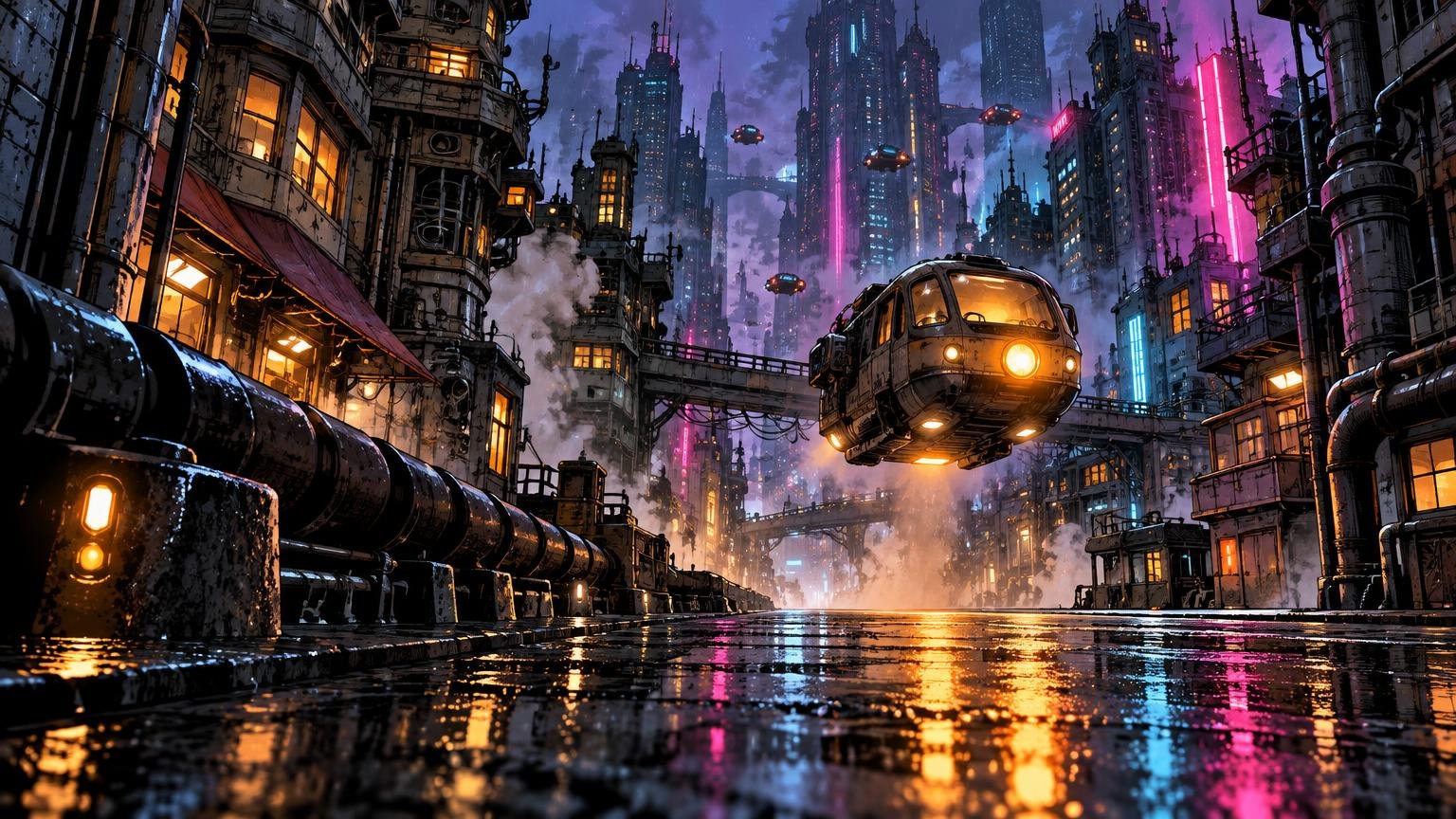
Blade Runner still looks more tangible than most cinematic futures because it was not designed as a collection of cool objects. It was built as a complete environment with economic layers, obsolete machinery, repurposed architecture and weather that seems to have been falling for decades. The miniatures have mass. The rooms feel occupied. Even the light appears dirty.
Released in the United States on June 25, 1982, Ridley Scott’s film brought together cinematographer Jordan Cronenweth, production designer Lawrence G. Paull, visual futurist Syd Mead, writers Hampton Fancher and David Peoples, and composer Vangelis. Its visual-effects work received an Academy Award nomination. More than four decades later, the movie remains essential viewing for anyone interested in model making, set dressing, lighting or the difficult art of making an imaginary city feel used.
TLDR: Blade Runner makes the future feel physically inhabited
Blade Runner is a masterpiece of accumulated detail. Its greatest achievement is not any single spinner, neon sign or rain-soaked street. It is the way sets, miniatures, lighting, optical effects, sound and performances all describe the same exhausted world. The pacing is deliberate and the plot withholds more than it explains, but that restraint is part of its power. For a first viewing today, the 2007 Final Cut is the strongest place to start.
A future assembled from layers, not polished clean
Syd Mead described the design philosophy as “accumulative-accretion”: technology is repaired, enlarged and layered over rather than neatly replaced. His work expanded from vehicles into architecture, streets and interiors, with detailed color renderings guiding Paull’s art department. The result is a future that has not escaped history. It has bolted new hardware directly onto the old walls. The American Society of Cinematographers’ production-design history documents how that approach shaped the city.
That principle is visible everywhere. Pipes run across facades instead of disappearing behind them. Signs compete for attention in several languages. Deckard’s apartment looks solid but imperfect, with systems that residents patch, tape and bypass rather than restore. The future is advanced enough to manufacture artificial people, yet ordinary maintenance still loses its eternal war against landlords, budgets and human impatience.
The contrast between social levels makes the city readable. Street spaces are dense, grimy and crowded, while the Tyrell Corporation occupies a monumental executive realm. Paull called Tyrell’s black-marble domain “Establishment Gothic,” an excellent description of a room that combines corporate authority, temple architecture and the cheerful warmth of a tomb. Production design is doing narrative work before the characters explain who has power.
The city also gains credibility by absorbing recognizable Los Angeles architecture. The Warner Bros. New York Street backlot was buried beneath ducts, pipes and signage. Frank Lloyd Wright’s Ennis House supplied Deckard’s exterior, while the Bradbury Building became Sebastian’s building and the setting for the climax. These locations retain traces of their real age beneath the futuristic additions. Blade Runner does not erase the past to create tomorrow; it lets tomorrow parasitize it.
Miniatures that understand scale
The photographic-effects unit combined miniatures, matte paintings, front projection, motion control and optical compositing. It involved more than 50 people and produced more than 90 effects shots, with much of the material photographed on 65mm to limit grain through successive optical generations. That technical discipline matters because the effects are not presented as isolated spectacle. They establish geography, atmosphere and the enormous imbalance between individuals and the structures surrounding them.
The opening “Hades” landscape is a model-building fever dream with sound engineering attached. Forced-perspective silhouettes were acid-etched into brass, smoke created depth, and roughly seven miles of fiber-optic strands ran beneath the miniature tables. Flares and lights were photographed in separate passes. VFX Voice’s account of the Blade Runner miniatures shows just how much physical and photographic problem-solving sat behind those few overwhelming minutes.
The Tyrell pyramid is equally instructive. Its miniature used a clear plastic shell, layered surface detail and hand-scraped window areas. Internal illumination came from a bare 10K lamp, producing enough heat to demand substantial stage cooling. Spinner models ranged from around one inch to 50 inches, with the larger versions carrying lights, motors, cables and nitrogen-exhaust plumbing. These were not merely detailed display models. They were working performance rigs designed to interact with light and atmosphere.
That interaction is why the models still feel heavy. Smoke produces aerial perspective, reducing contrast and apparent detail with distance. Timed interactive lighting makes separately photographed elements appear to illuminate or affect one another. The eye receives consistent depth cues, so it accepts the composite as a place rather than a stack of ingredients. Modern tools can produce more complex images, but complexity alone does not supply scale. Blade Runner’s effects artists understood that scale lives in light, atmosphere and movement as much as in surface detail.
For another modern example of physical craft supporting cinematic scale, our Dune: Part Two review for prop and miniature fans examines a very different desert world built around similarly disciplined visual choices.
Light, smoke and rain become architecture
Cronenweth said Scott wanted a photographic approach informed by Citizen Kane, including high contrast, unusual angles and shafts of light. He summarized the film’s working vocabulary as “contrast, backlight, smoke, rain and lightning.” That list sounds simple until you notice how completely it governs the movie. Light rarely exists just to make a face readable. It cuts rooms into zones, hides ceilings, catches suspended moisture and turns windows into barriers.
The low ceilings forced illumination through windows or up from floor level, strengthening the feeling of confinement. Practical neon signs became light sources, sometimes operated on dimmers just above the point of flicker. During Zhora’s chase, neon units were moved into storefront windows and high-speed pulsing became part of the image. The result is not generic “neon noir.” The sources belong to the environment, so the color feels motivated even when the composition becomes expressionistic.
The famous replicant eye glow was also achieved practically. A half-silvered mirror placed at 45 degrees in front of the camera reflected light along the lens axis and back from the performers’ eyes. Scenes could be photographed with and without the effect, preserving editorial choice. It is a subtle technique because the glow is not treated as a flashing label that announces a plot fact. It is an uneasy visual suggestion, appearing almost like an animal reflection caught at night.
This disciplined use of visual language is why Blade Runner belongs in the same design conversation as films with more immediately legible factions and vehicles. Our analysis of shape language in Rebel and Imperial production design explores another way that architecture, materials and silhouette can communicate identity before dialogue catches up.
The city is built with sound too
Vangelis’ score combines synthesizer-led textures with noir, jazz, classical and Middle Eastern inflections. Scholarship on the film describes a cohesive acoustic environment made from ambience, voices, noise and music, with relatively music-led aerial sequences contrasted against dense street-level sound. The University of Sydney’s discussion of the score provides useful context for how its electronic music engages with the film’s questions about humanity.
That vertical contrast is crucial. Above the city, the score can stretch outward and make the skyline feel melancholy, majestic and almost abstract. On the ground, announcements, engines, voices, rain and mechanical noise crowd the listener. The same city feels mythic from a spinner and oppressive from the pavement.
The soundtrack also refuses the easy binary of synthetic versus human. Electronic tones can be warm, mournful and vulnerable; acoustic associations can feel distant or artificial. Vangelis does not merely decorate the production design. He gives its wet surfaces and unreachable towers an emotional climate.
Performances keep the design from becoming a museum exhibit
Harrison Ford’s Deckard moves through the city with fatigue rather than heroic command. Sean Young gives Rachael a carefully composed stillness that gradually reveals emotional injury. Rutger Hauer’s Roy Batty supplies the movie’s most volatile energy: playful, furious, frightened and finally lucid.
Roy’s final speech is sometimes described as entirely improvised, but that flattens a better story. Hauer retained two scripted lines, added material about having too little time and devised the “tears in rain” phrase, reworking and expanding the speech rather than inventing it wholesale on the spot. Its power comes partly from that compression. The movie’s immense city suddenly narrows to one being trying to preserve memories that nobody else can access.
The performances also prevent the film’s ambiguity from becoming a hollow puzzle box. Whether Deckard is human or replicant is less important than the destabilization itself. Scott has supported a replicant interpretation, Ford has rejected it, and Fancher preferred the question to remain unresolved. The National Film Registry essay on Blade Runner outlines how the competing versions and creative viewpoints sustain that uncertainty. The question works because it turns the film’s machinery of identification back on the investigator.
Which version should you watch?
The major released versions include the 1982 U.S. theatrical cut, the international cut, a workprint, the 1992 Director’s Cut and the 2007 Final Cut. The U.S. theatrical release includes Deckard’s voice-over and a more conventionally optimistic ending. The Director’s Cut removes that narration and ending while adding the unicorn dream, which strengthens the evidence behind one reading of Deckard’s identity.
The 2007 Final Cut is Scott’s later revision and is not identical to the 1992 Director’s Cut. It retains the no-narration approach while incorporating further restoration and revision work. It is the best entry point because it gives the images, sound and ambiguity room to operate without the theatrical cut’s explanatory guidance.
The theatrical version remains worth seeing afterward. Its narration changes the rhythm and pushes the film toward hard-boiled detective convention, while its ending releases tension that the later cuts preserve. Comparing them is not just completist homework. It demonstrates how editing and narration can alter the meaning of identical sets, performances and shots.
The final verdict
Blade Runner endures because its craft departments appear to have designed the same world rather than competing for the coolest individual moment. Mead’s accumulated machinery, Paull’s monumental rooms, Cronenweth’s fractured light, the effects team’s smoke-filled miniatures, Vangelis’ aching electronics and the cast’s guarded performances all reinforce one idea: technological sophistication does not make life cleaner, fairer or easier to understand.
Its deliberate pace will frustrate viewers expecting a conventional action thriller, and its mysteries are designed to remain partly unresolved. Accept those terms and it becomes one of science fiction’s richest physical environments—a city that feels tangible because every surface, sound and shaft of light suggests something existed before the camera arrived. Watch the Final Cut first, turn the room lights down, and pay attention to the backgrounds. In Blade Runner, the background is never merely background.
References
- AFI|Catalog
- Search Results – Academy Awards Search | Academy of Motion Picture Arts & Sciences
- Discussing the Set Design of Blade Runner
- Blade Runner: Cronenweth’s Photography
- Blade Runner: Special Photographic Effects
- The Miniature Models of BLADE RUNNER – VFX Voice
- How the Blade Runner soundtrack used electronic music to explore what it means to be human – The University of Sydney
- Sound and Perception in Ridley Scott’s Blade Runner (1982)
- Bloody Hell: An Oral History of the Making of 'Blade Runner' – LAmag
- film essay for "Blade Runner"
- Read the Full Transcript of Wired's Interview with Ridley Scott | WIRED
- Blade Runner (1982)
- Blade Runner